

Apple Is Pivoting to Smart Glasses. The NHS Just Earmarked £210m for VR. Only One of These Is the Future of XR.
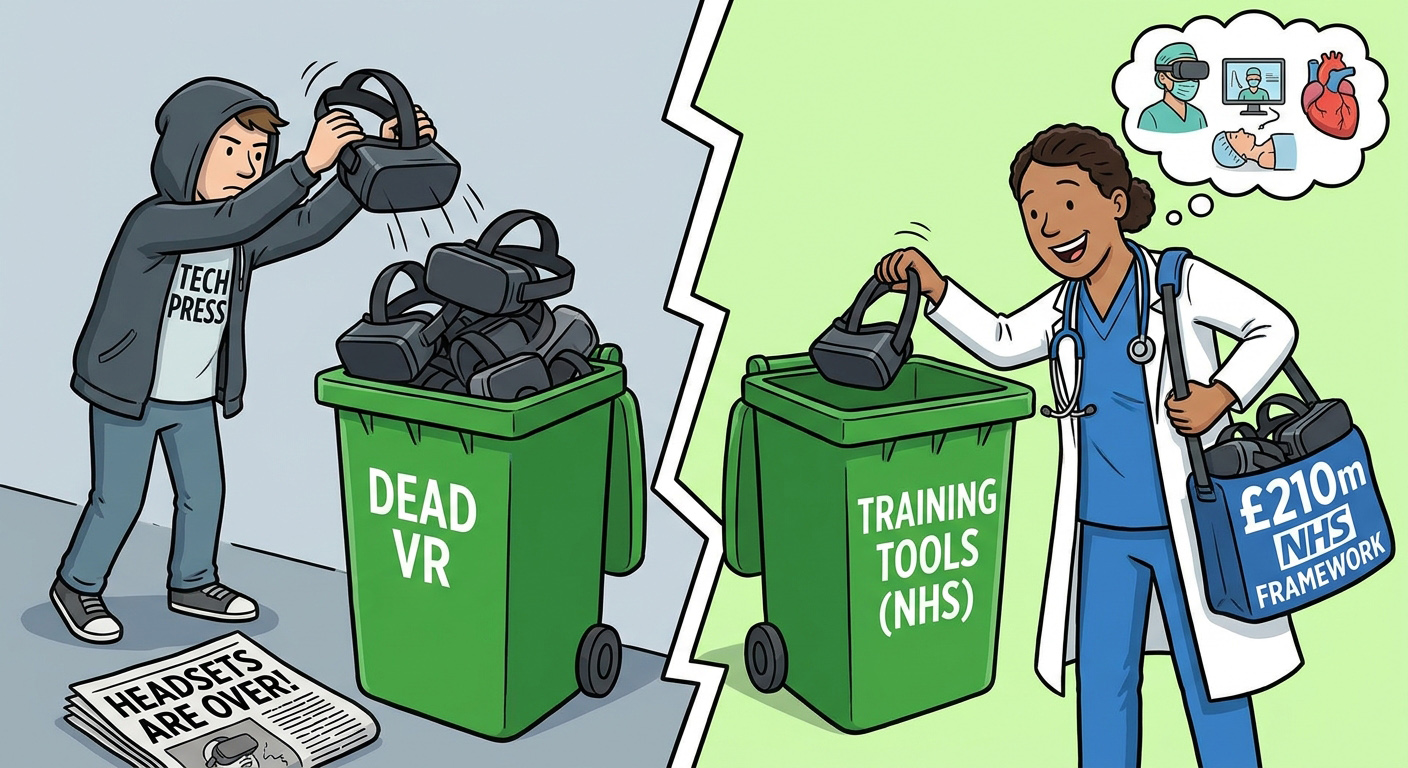
The dominant XR story of spring 2026 is a headset retreat. Apple is reportedly shelving the standalone Vision Pro in favour of smart glasses for late September. UploadVR has Quest 4 slipping to 2027 or 2028. Trade reporters are recycling obituaries for the headset era.
We have spent fifteen years making immersive content for clients from Bentley to the BBC. We do not see a retreat. We see a pivot, and it is worth being honest about what the pivot actually is.
What Just Happened in the XR Industry
In February, NHS Supply Chain published a pipeline notice for a national framework agreement covering medical simulation devices and immersive technologies. The headline number is £210m excluding VAT, or £252m with VAT. The framework is split into two lots. Lot 1 is virtual reality simulation systems, augmented reality trainers, mixed reality platforms, immersive projection rooms and simulation domes. Lot 2 is manikins and task trainers. The tender publishes on 2 July, with contracts running from 9 May 2027 to 8 May 2029, extendable to 8 May 2031. The notice explicitly invites SME and social enterprise participation.
In the same window, Bloomberg’s Mark Gurman reported that Apple is on track to unveil smart glasses in September or October 2026, deliberately timed to disrupt Meta’s holiday quarter. The first generation will skip displays altogether. Cameras, microphones, speakers, Apple silicon, and Visual Intelligence: an ambient computing accessory built around capture, not output.
Meanwhile, a March 2026 Privacy Guides investigation reported that Meta had been routing recordings from its Ray-Ban smart glasses – including bank details, naked people, and intimate moments captured inside users’ homes – to data annotators at Sama in Kenya. Users could not opt out of automatic submission for review. Face-blurring was reportedly partial. Meta sold roughly seven million pairs in 2025. Snap has now confirmed its own consumer Specs for later this year, citing $3bn of development spend.
Two Stories, Two Different Futures
It is tempting to read these as a single story about XR maturing. They are not. They are two stories about who XR is for.
The smart glasses pivot is, before anything else, a business-model decision. A headset that you wear for a meeting or a workout is hard to monetise as an ad surface. A camera-equipped pair of glasses you wear for sixteen hours a day is the most valuable consumer-data product anyone has shipped since the smartphone. That is why Meta has been investing in it for a decade and why Apple is willing to ship a first-generation product without a display. The privacy questions in the Sama story are not edge cases. They are the unit economics surfacing.
The NHS framework points at a different future. The buyers are training departments, simulation centres and educational suppliers. The use cases are concrete: surgical rehearsal, decontamination drills, paediatric airway management, communication training, scenario-based skills assessment. The contracts are five-to-eight years long. The technology has to earn its place inside an existing professional workflow, audited by people who will lose their jobs if it does not work. There is no advertising layer. There is no incidental data harvest from the patient’s home. The discipline is context, not exposure.
What This Means for Brands and Creators in XR
If you are commissioning or making immersive work over the next five years, this is not a moment to follow the consumer-hardware narrative. It is a moment to be very precise about where XR earns its keep.
Three observations from where we sit.
First, the institutional money is in context-specific immersion. Training, simulation, heritage, healthcare, brand experience – the things that have a defined audience, a defined outcome, and a defined moment of use. The £210m NHS framework is the most visible UK example, but the same logic is showing up in defence simulation, manufacturing skills, university education, and museum digitisation. It is not coincidence that these all have professional buyers in the loop.
Second, the always-on glasses model is an ad and data product, not a creative platform. You can make work for it – some of it will be brilliant – but expecting it to behave like the open web of immersive media is naive. The platform companies are pivoting precisely because the headset business does not deliver the data they need to subsidise hardware development. Anyone designing for that surface should be reading the Sama story carefully.
Third, the work that ages well is the work that has a reason to exist. We have built training experiences for Mission Rabies and St John Ambulance, brand worlds for The Macallan and Guinness Storehouse, automotive experiences for Bentley, Audi and Land Rover, and cultural projects for the BBC and BFI. None of those required everyone to be wearing a piece of hardware all day. They required someone to be in the right context, for the right reason, for a defined length of time. That is the same principle the NHS framework is built on, and it is the principle that scales.
See It in Action
We explored similar questions in our work with Mission Rabies and The Macallan – immersive experiences that earn their place because they fit the context, not because they live on the user 24/7. Explore the full portfolio at visualise.com/work.
If you are exploring how immersive technology can work inside a specific training, brand or heritage context, we would love to talk. Get in touch at visualise.com/contact.
Comments