

Who Consented to the Camera? Smart Glasses Arrive in London
In three weeks, smart glasses stop being a tech-show curiosity and become a high-street product. On 22 July, Samsung will use its Galaxy Unpacked event in London to launch an Android XR pair built around Google’s Gemini assistant and a 12-megapixel camera. Meta’s Ray-Ban glasses are already a common sight on British streets, and Google’s own design is close behind. The hardware has quietly crossed the line from prototype to something people will actually wear every day. That is genuinely exciting. It also raises a question the industry keeps sidestepping: who looks out for the person on the other side of the lens?
The smart-glasses war reaches London
For years the “eyewear war” was a forecast. In mid-2026 it is a release schedule. Samsung’s Galaxy Unpacked, held in London, is expected to confirm a pair of Android XR glasses with onboard cameras and microphones, with the heavy processing offloaded to a paired phone and Gemini handling the clever bits. It follows Samsung’s Project Moohan headset and arrives into a market where Meta’s second-generation Ray-Ban glasses already pack a 3K camera into a frame that looks, deliberately, like ordinary eyewear.
The design goal across all of these products is the same: make the technology disappear. That is a remarkable engineering achievement and, simultaneously, the heart of the problem. A device designed to be indistinguishable from normal glasses is a device designed to record people who have no idea they are being recorded. The convenience for the wearer and the exposure for everyone else are two sides of the same feature.
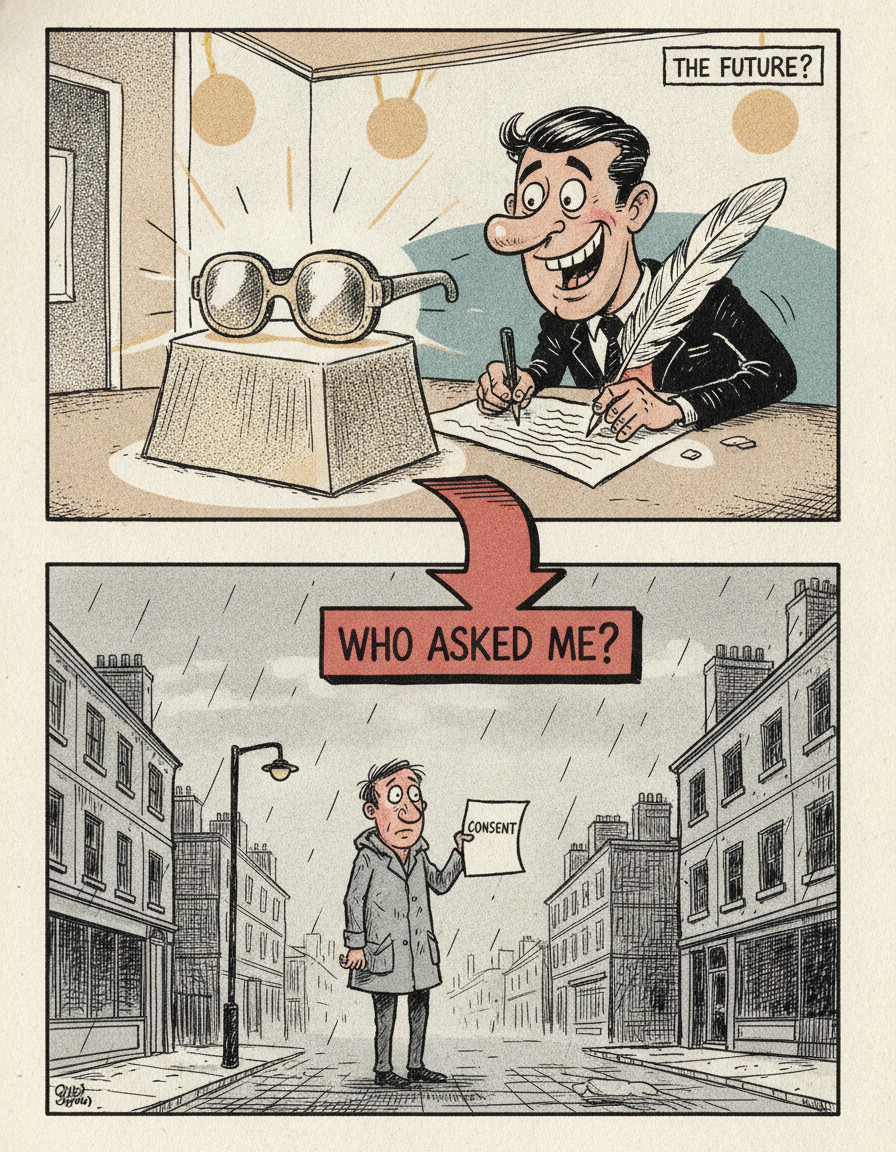
Consent was never the wearer’s to give
We have spent fifteen years making immersive films in real, public places, so consent is not an abstraction for us – it is a daily, practical part of production. Every recognisable face that lands in a 360 film needs a release. It is slow, occasionally awkward, and absolutely the right thing to do, because the people in the frame are not our clients and never agreed to be part of the work.
Smart glasses dissolve that contract by design. A pair of camera glasses involves two parties: the wearer, who accepted the terms, and everyone in front of them, who never saw them. The recording indicator on the current generation is a small LED that reviewers consistently describe as too faint to notice in daylight, which means the one social signal that used to matter – “you are being filmed” – has effectively been switched off. In the United States, the lawsuit Bartone v. Meta, filed in March 2026, is already testing whether even buyers understood how captured footage is transmitted, stored in the cloud, and reviewed by humans. The bystander, needless to say, was never asked at all.
A policy moment that misses the point
This lands in a peculiar moment for UK regulation. The Data (Use and Access) Act received Royal Assent on 19 June 2026, updating the country’s data-protection framework, yet there is still no dedicated law governing wearable cameras. At the same time, official surveillance is under serious scrutiny: the Metropolitan Police disclosed more than 1.7 million live facial-recognition searches in 2025, and the Equality and Human Rights Commission found earlier this year that one of its deployments was unlawful. In the EU, the AI Act’s core transparency obligations become applicable on 2 August 2026.
So the rules are tightening around the state’s cameras, and rightly so. The strange gap is that a consumer version of the same capability – millions of always-on cameras, worn at eye level, pointed at whoever happens to be nearby – is about to launch with almost no equivalent oversight. We are regulating the cameras on the lamp posts while the cameras on people’s faces walk out of a shop in Stratford unremarked.
What this means for brands and creators in XR
For anyone building in immersive technology, this is not a reason to retreat. It is a reason to lead with better defaults. The most trusted XR experiences of the next few years will be the ones that treat consent as a design feature, not a legal afterthought. That means honest, obvious recording indicators rather than aesthetic ones. It means being transparent about where footage goes and who can see it. It means designing capture experiences – whether that is a branded AR activation, a volumetric shoot, or a smart-glasses app – around the assumption that the people in frame deserve a say.
Brands considering a wearable or capture-led campaign should ask their production partners a simple question early: what is your plan for the people who didn’t sign up? At Visualise, that plan is the releases, the signage, the briefed crew, and the editorial judgement we have built over fifteen years of shooting in public. The technology is changing fast. The duty of care underneath it should not.
See it in action
We think about consent and capture on every shoot we run, from public-space 360 films to live immersive activations. Explore how we approach immersive production at visualise.com/work.
If you are planning an immersive or wearable-led experience and want it to be brilliant and responsible in equal measure, we would love to talk. Get in touch at visualise.com/contact.
Comments