

The Year XR Got Good Is the Year It’s Further From Reach
Something shifted in immersive technology this week, and it has nothing to do with a spec sheet. On Tuesday 8 July, Samsung’s Galaxy XR goes on sale in the UK – the first headset built on Android XR, Google and Qualcomm’s new spatial platform. It is, in our view, the first spatial computer we would happily recommend to someone who does not work in this industry. That is a bigger moment than it sounds, because it changes the question we should all be asking – from “is this any good?” to “who actually gets to use it?”
The first headset people might actually want
For years, the honest answer to “should I buy a VR headset?” was “probably not yet.” The hardware was heavy, the software thin, the reasons to keep it on your face few. The Galaxy XR is different. It runs a Snapdragon XR2+ Gen 2, with micro-OLED displays at 3,552 x 3,840 resolution, a wide field of view, and multimodal control by voice, gaze and gesture. The AI layer – Google’s Gemini, woven through the interface – finally looks less like a party trick and more like something you would use to get work done. It costs around £1,699.
And it is not alone at the top of the market. Apple’s Vision Pro – arguably still the most capable spatial computer you can buy – sits at £3,499. This is not one company’s pricing decision; it is where the whole category has landed. The best of spatial computing now starts at four figures.
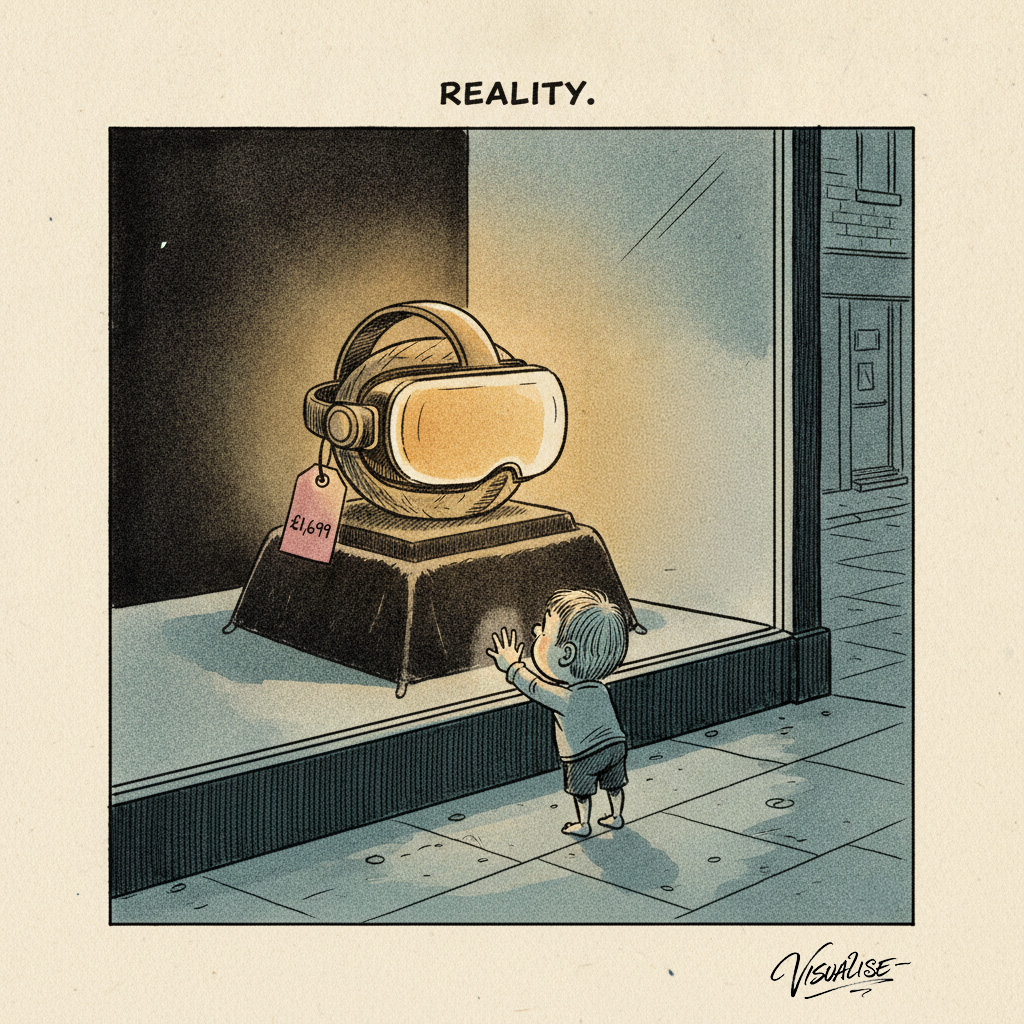
Why “good” is exactly when access stops being theoretical
We have spent 15 years making immersive content – 360 films, VR experiences, virtual production – for clients including Google, the BBC and Bentley. From that vantage point, the tools have never been better. But there is a catch buried in that good news. While XR hardware was clunky and niche, the question of who could afford it was academic. Nobody was excluded from a thing they did not want. For years, being priced out of XR meant missing a gimmick. Now it means missing something real.
Consider where the Galaxy XR is landing. The UK Government’s own Digital Inclusion Action Plan, in its one-year progress report, counts 1.6 million people with no internet connection at all, and around 1.7 million households without a laptop, tablet or desktop computer of any kind. And it arrives at a moment when household budgets are under sustained pressure – when a four-figure discretionary purchase is further from most families’ reach than it has been in years. Spatial computing is arriving as a premium tier stacked on top of a digital foundation that millions of people still do not have.
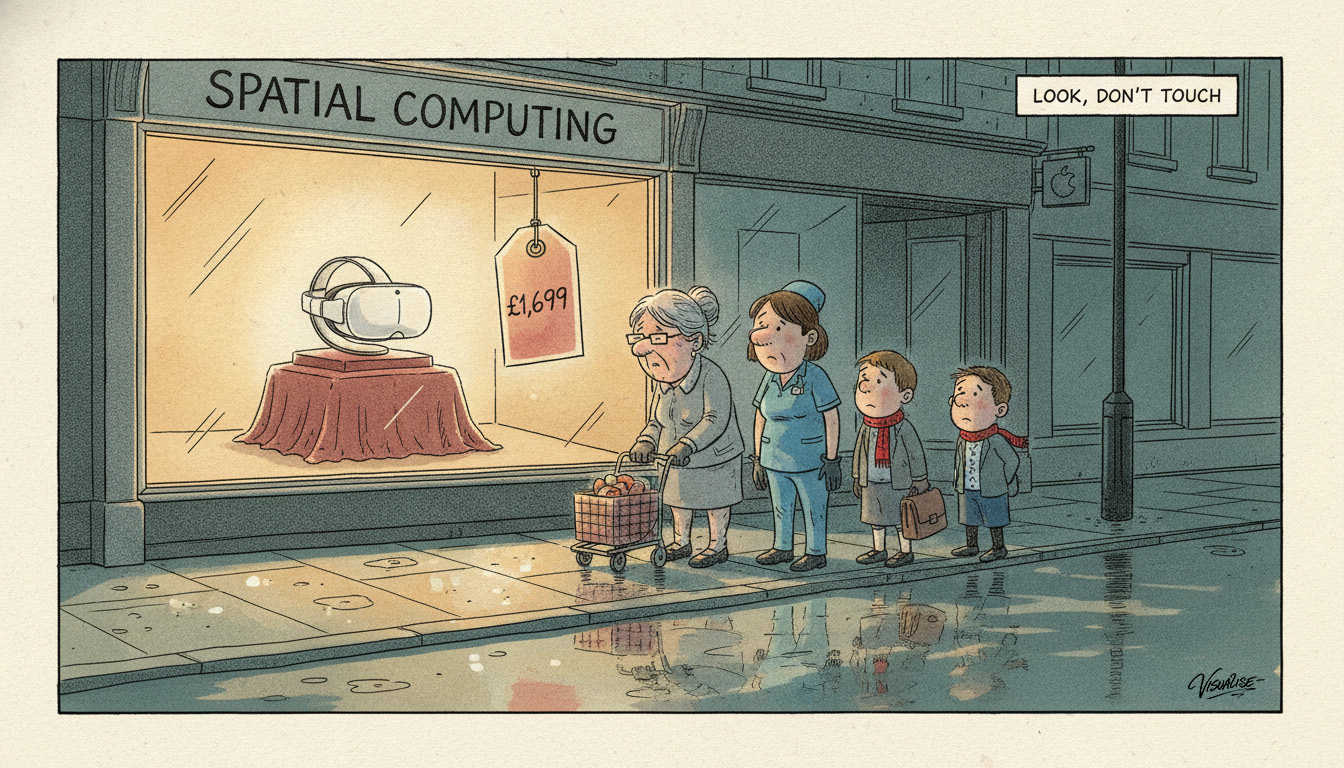
The gap will not close itself
A £1,699 headset is not a villain, and Samsung and Apple are not doing anything cinema, hi-fi or the personal computer did not do before them: new categories launch at the top and work down. But the promise of spatial computing – the thing those of us who make it actually believe in – is learning, training, storytelling, presence. Those are precisely the applications where exclusion costs the most. The better this technology gets, the more it costs to be left out.
The hardware does not decide who gets access. Pricing decides it. Public procurement decides it. The choices brands and creators make about where their work can be seen decide it. We decide it.
What this means for brands and creators
There is a hopeful counterpoint in the same week’s news. On 2 July, NHS Supply Chain published more details on its £210m framework for medical simulation, with a dedicated lot for VR, AR and mixed-reality training (we’ve mentioned this brilliant initiative in previous posts). It is a concrete signal that when there is a clear public purpose, immersive technology attracts serious, sustained funding. That matters for anyone building in this space: the strongest XR work is not the flashiest headset demo, it is the experience that solves a real problem for a defined audience – a surgeon rehearsing a procedure, a student walking through a collection their school could never visit, a customer understanding a product they cannot yet touch.
For brands considering immersive experiences, the lesson of this week is to build for reach, not just spectacle. The most durable projects assume that not everyone owns a £1,699 headset – and reach people on the web, on the phones already in their pockets, and through shared, curated spaces rather than locked ecosystems. Desirability is finally on our side. Accessibility has to be a deliberate choice on top of it.
See it in action
We have spent years wrestling with exactly these questions – how to make immersive work that reaches people rather than gatekeeping them. Explore our work at visualise.com/work.
If you are exploring how immersive technology can reach your audience – not just the ones with the latest headset – we would love to talk. Get in touch at visualise.com/contact.
Comments