

The Best of XR Right Now: The Immersive Toolchain Just Grew Up
Most of the XR headlines this year have been about hardware: which headset is being cancelled, which one is priced out of reach, which company is pivoting to glasses. It makes for good drama, but it is not where the meaningful progress is happening. The meaningful progress is in the plumbing – the capture tools, file formats and rendering layers that decide what any of us can actually make and put in front of an audience. And in the first half of 2026, several of those foundations levelled up at the same time.

Here are four developments that will not have troubled the front pages, but that genuinely change what a working immersive studio can build and ship right now.
Gaussian splats became a real file format
Start with the one that sounds most technical and matters most. Khronos, the standards body behind glTF, is folding Gaussian splats into the format – the same glTF that already carries 3D content across the entire web. The extension has backing from NVIDIA, Autodesk, Esri, Niantic Spatial and Bentley Systems, and moved to release candidate earlier this year with ratification following in Q2.

Gaussian splatting is the technique behind those uncannily photoreal captured scenes that have been circulating – real places and objects reconstructed with a depth and softness that traditional meshes struggle to match. The catch, until now, was that every splat was effectively trapped inside whatever bespoke viewer created it. There was no reliable, shared way to store one, move it, or open it somewhere else.
A standard format changes that completely. As Khronos president Neil Trevett put it, the goal is to help the technique “scale across tools, platforms, and the web”. In practical terms, a splat stops being a one-off demo locked to a single application and becomes an asset you can carry through a normal production pipeline, hand to a client, and open in a browser. That is the difference between something impressive in a meeting and something you can actually deliver.
Volumetric capture now drops straight into Unity
Standards matter, but so does the capture end of the pipeline, and there the news is just as good. At AWE USA in June, 4Dviews unveiled a Unity plug-in for its HOLOSYS Splat system that exports volumetric captures directly into the engine – as Gaussian splats or as traditional mesh and textures, depending on what the shot needs.

What caught our attention is what it preserves. Hair, fur, reflective and translucent surfaces – the things that have always defeated clean volumetric reconstruction – come through intact. For anyone who has sat through a volumetric shoot and then waited days for a mesh that still mangles someone’s hair, a pipeline that gets you a usable result in the engine almost immediately is a real change to how a production runs, and how much it costs.
The browser has all but caught up with native
For years, the honest trade-off with WebXR was quality for convenience: a web experience needed no download, but it looked like a web experience. That gap has narrowed dramatically. WebGPU brings near-native rendering performance to the browser, and foveated rendering – drawing only the area you are actually looking at in full resolution – claws back a large share of the GPU budget on top. WebXR adoption is up around 40% this year, with full support across Chrome, Edge, the Meta Quest browser, and Safari on Apple’s headset.
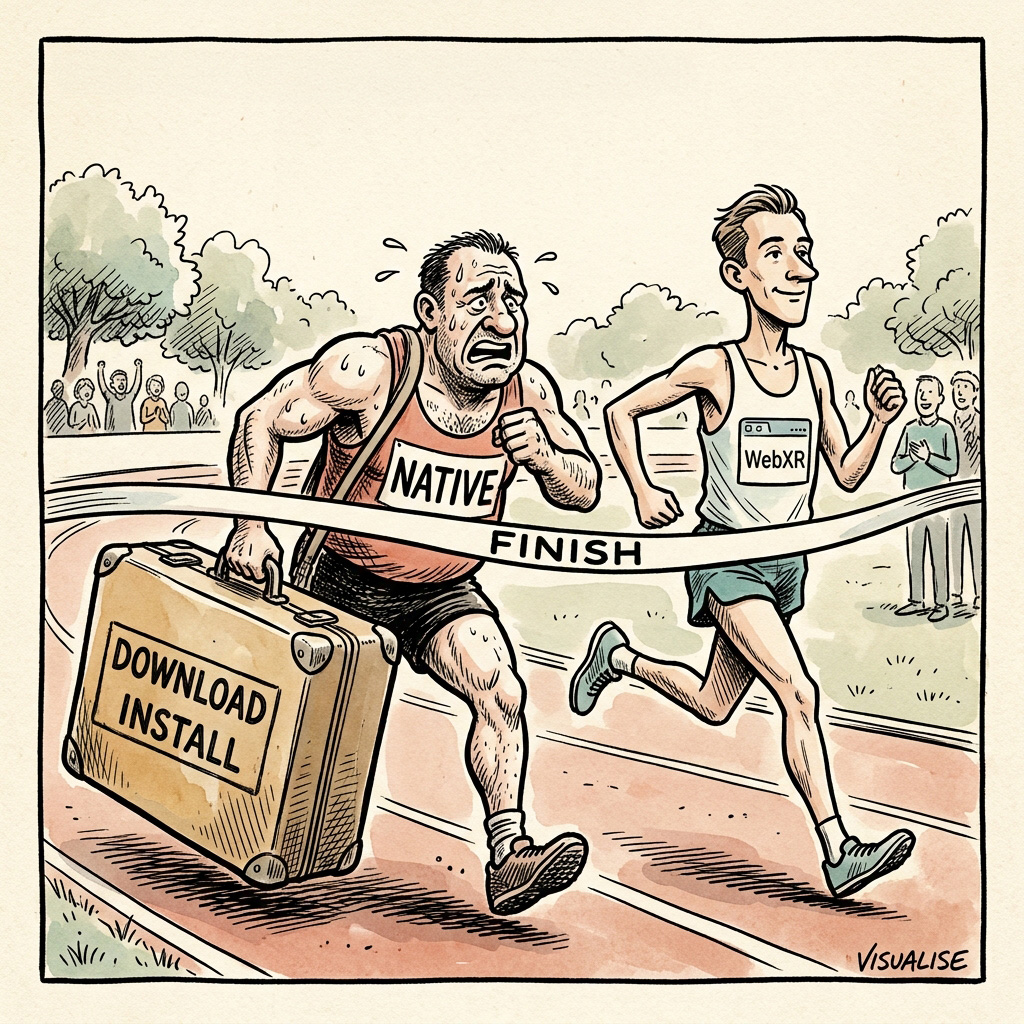
The upshot is that the no-download, works-from-a-link version of immersive is now genuinely good, not merely handy. For brands and institutions who want to reach the widest possible audience – most of whom will never own a headset – that matters enormously.
Prototyping in plain English
The last one is more of a preview of where tooling is heading, but it is real and open-source today. Google’s XR Blocks framework, paired with its Gemini model, turns a plain-English prompt into a working, physics-aware WebXR scene in under a minute. Ask for “a dandelion that blows away when I pick it up” and you get a functioning, interactive scene you can test on a desktop simulator or on a headset.

It will not produce your final build, and it should not be mistaken for one. But for getting a rough spatial idea in front of a client the same afternoon you discussed it, that collapse in iteration time is a meaningful shift. The slowest part of early-stage immersive work has always been the gap between “what if we did this” and “here, try it”. That gap is closing.
See It in Action
Every one of these developments touches the way we work: volumetric capture, real-time delivery, and the no-app, just-a-link experiences we build for audiences who will never put on a headset. Explore our work at visualise.com/work.
If you are exploring how immersive technology can bring a place, a product or a story to a wide audience – on the web or in a headset – we would love to talk. Get in touch at visualise.com/contact.
Comments