

The Agent Can Now Put the Headset On: The XR Developments That Matter Right Now
Almost every conversation about AI in immersive development has been about generating code. All of the testing in headsets had to be done by a human. The release that matters most from the last fortnight does the opposite job: it lets the AI agent check the result. Meta shipped it on 28 July with very little fanfare, and if you make XR for a living it is a very important movement.

An agent that can strap in
Meta XR Operator reached its first public release, version 205.1, on 28 July 2026. It gives an MCP-compatible agent, such as Claude Code, the ability to observe and interact with a running VR or MR application rather than working blind against source code.
In practice the agent can read room geometry and the Unity scene hierarchy, capture screenshots of the app exactly as it renders in the Meta XR Simulator or on a physical Quest, drive Touch controller input including buttons, thumbsticks, triggers and aim, and set head position and orientation to walk through a multi-step interface flow. Meta describes the goal as “closing the loop between code changes and runtime validation”. Unity developers get it bundled inside the Meta XR Core SDK; a standalone package covers Unreal and native projects.
The reason this is the more consequential half of AI-assisted XR development is that writing the code was never where projects lose their days. You cannot unit-test presence. A headless test suite can confirm a function returns the right value, but it cannot tell you that a menu spawned inside a wall, that a hand-tracked control sits just out of comfortable reach, or that a transition induces a lurch. Someone has to put the headset on, look left, look behind them, and check. Then do it again after the next build.

Fifteen years into making immersive work, we would call that the least discussed cost in the medium. It never appears as a line item, it is impossible to sell to a client as a deliverable, and it scales badly: the longer and more branching the experience, the more headset hours it eats. A tool that automates the repetitive passes is worth more attention than most hardware announcements.
The proof case shipped in the same fortnight
If you want the clearest illustration of the bottleneck, look at the Halo MCC VR alpha published on Nexus Mods. It is a native C++ OpenXR layer for Halo 3, ODST and Reach, with 6DOF head tracking, motion-controlled aiming, per-title vehicle controls and an in-VR settings menu.
Claude and Codex wrote the code. A human modder made every reverse-engineering decision and, crucially, performed every headset test by hand. The AI could produce a rendering layer; it could not tell whether the result was playable. That gap between generated code and verified experience is precisely what Operator is aimed at, and seeing both land within days of each other makes the point better than any roadmap slide.
The web side moved too
Meta also open-sourced the agentic pipeline behind its Immersive Web SDK under an MIT licence. It exposes 32 MCP tools and a retrieval server indexing more than 3,300 code chunks, letting an agent query the scene graph, inspect entity state, read console logs, screenshot the running experience and diagnose its own failures before correcting them.
The headline benchmark is that Meta rebuilt Project Flowerbed, an experience that originally took tens of thousands of lines of custom code, from scratch in 15 hours. Treat that number with the usual caution about internal teams rebuilding something they already understand, but as a reference point for costing a WebXR prototype it is a genuinely useful data point.
What this changes for anyone commissioning immersive work
The practical implication is about where headset hours go, not whether they disappear. On a long-form piece, a small change in scene three can quietly break something in scene nine, and finding it costs an afternoon of someone strapping in and walking the whole thing again. Handing those regression passes to an agent means the human headset time gets spent on the questions that actually need a person.
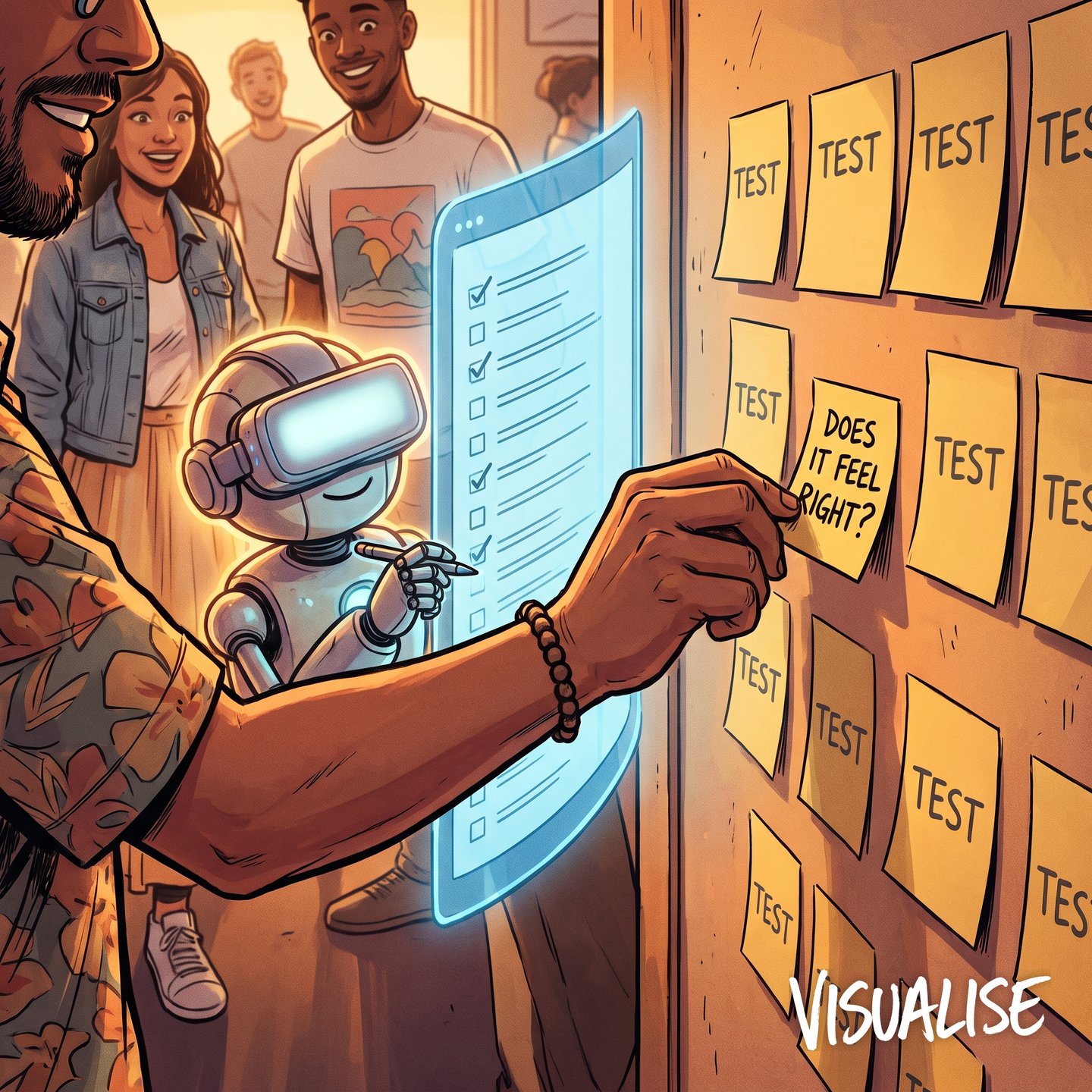
For brands and institutions commissioning immersive work, the honest read is this: expect prototyping and iteration to get faster and cheaper over the next year, and expect that to show up as more options explored rather than a smaller invoice. What will not compress is the judgement. An agent can now confirm the menu opened. It cannot tell you whether the room felt right, whether the pacing held, or whether the moment landed for the person standing in it. That has always been the job, and none of this changes it.
See It in Action
Every immersive piece we make goes through exactly this cycle of building, testing in the headset, and rebuilding until it feels right. You can see the results across our work at visualise.com/work.
If you are exploring how immersive technology could work for your organisation, we would love to talk. Get in touch at visualise.com/contact.
Comments