

The Best Seat in the House Has Almost no Audience
Two live immersive broadcasts went out this summer. One is the most technically ambitious thing anyone has attempted in the format. The other one has an audience. The gap between them tells you more about where immersive broadcast is actually heading than any hardware announcement has in years.
The most ambitious live immersive broadcast yet attempted
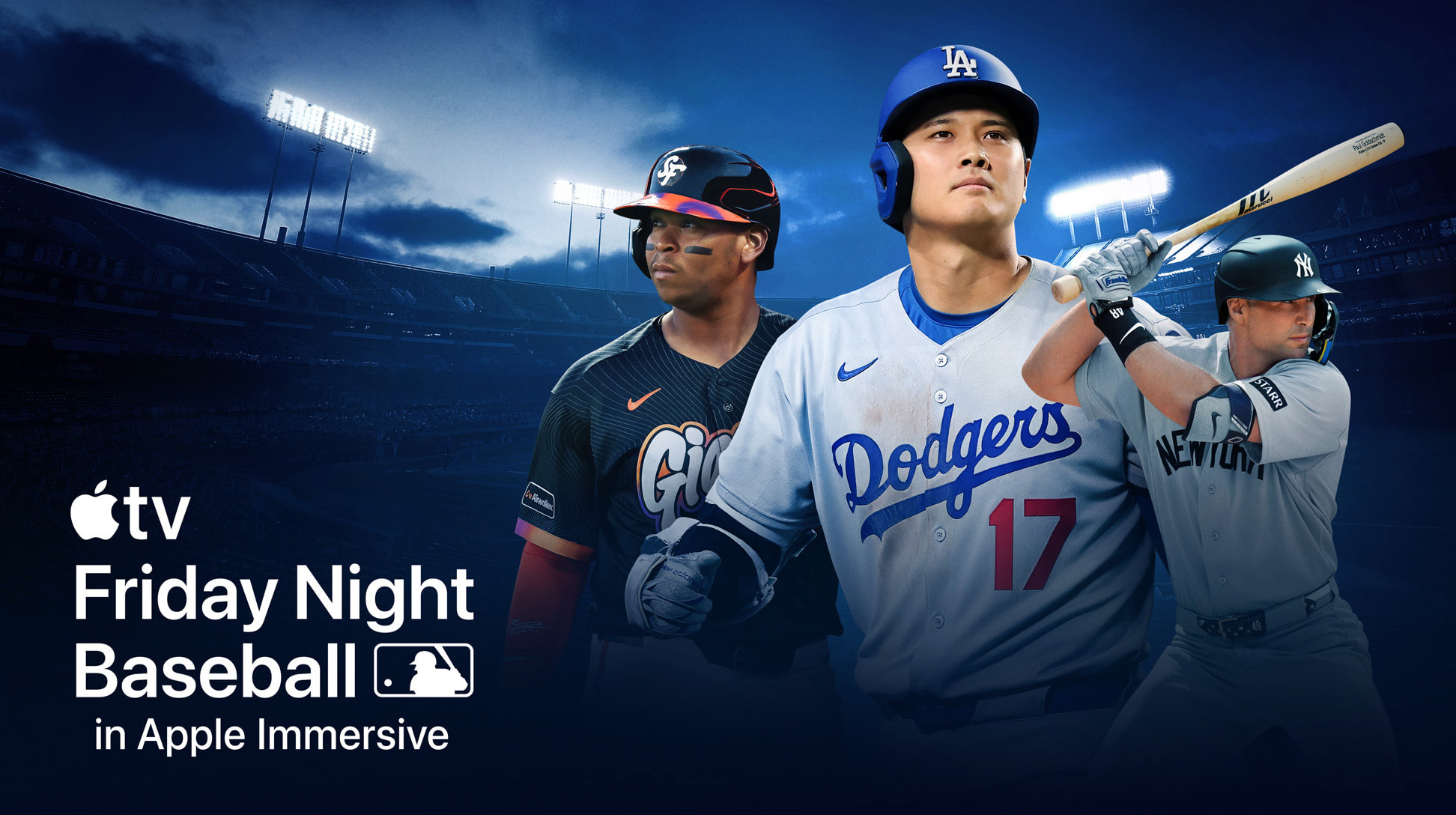
On 28 August, Apple begins streaming Friday Night Baseball in Apple Immersive, opening with the Boston Red Sox at the New York Yankees. The specification is not a gimmick. Apple is recording 3D video in 8K at a 180 degree field of view, capturing spatial audio with ambisonic microphones through breaks in play, and running a dedicated commentary team of Paul Severino on play by play, Xavier Scruggs as analyst and Michelle Margaux on the sideline. There is an immersive graphics package that floats team lineups and stats in the space around the viewer, plus dedicated replays. Four immersive games run through September, roughly one a week, with the Angels at the Pirates on the 4th, the Padres at the Giants on the 11th and the Giants at the Dodgers on the 18th.
The craft here deserves credit. Live stereoscopic capture at that resolution is one of the hardest jobs in broadcast. Interocular distance has to be right for the viewing distance, the rig has to survive a live event, latency has to stay inside a budget that gives you no room to think, and stitching errors that are forgivable in a flat cut become physically uncomfortable in a headset. Having spent fifteen years shooting live immersive content, we know exactly how much discipline is sitting behind that stream. A dedicated three person commentary team for a single immersive feed is also a genuinely new commitment.
Then there is the distribution. The feed requires an Apple Vision Pro. It requires an active Apple TV subscription, 12.99 US dollars a month in the United States. It is available in nine countries: Australia, Canada, Germany, Hong Kong, Japan, South Korea, Taiwan, the United Kingdom and the United States. Apple has never published Vision Pro sales figures, and analyst estimates put the total somewhere near 600,000 units since the 2024 launch. Meanwhile the analyst Ming-Chi Kuo reports that Vision Pro successors have been removed from Apple’s product roadmap entirely, in an overhaul he says was signed off by the company’s incoming chief executive, with the engineering focus moving to smart glasses in 2027 and 2029.
What Wimbledon did differently
Now consider the other significant live immersive moment of this summer. At Wimbledon, the All England Lawn Tennis Club worked with AKQA, Hawk-Eye Innovations and the BBC to launch the HawkAR Inclusive Feed, co-designed in consultation with the Royal National Institute of Blind People. It takes the ball and player tracking data Hawk-Eye already generates for officiating and converts it into a real time 3D soundscape, so that a blind or low vision viewer can hear the speed and trajectory of the ball as it is played. For viewers with some sight, HawkAR layers high contrast bounce points and shot paths over the picture. It covered every singles point on Centre Court for the duration of the Championships, and it went out free on BBC iPlayer, in the Audio Described section, across television, app and web.
Ben Crossing, chief executive of Hawk-Eye Innovations, put the scale of the audience plainly: almost 285 million people worldwide are prevented from enjoying live sport because of severe visual impairment.
The delivery device decides who gets in the room
The detail that matters most to us, as people who make this work for a living, is that the Wimbledon feed is not video at all. There is no camera position to argue about, no stereoscopic rig, no bitrate ceiling and no headset. The immersion is carried by spatial audio driven from a data feed that the tournament was already producing for another purpose. That is precisely why it reaches people. It runs on the phone, tablet or television that someone already owns, through a platform they already have, at no additional cost.
This is the trap we have walked into ourselves, more than once. It is very easy to specify the highest fidelity capture a budget will carry and then quietly assume the install base will arrive to meet it. It usually does not. We have shot beautiful 360 material for headsets that ended up being watched, overwhelmingly, on phones. The lesson is not that fidelity is wasted effort, because it plainly is not. The lesson is that fidelity and reach are separate design decisions, and pretending otherwise is how immersive projects end up with astonishing craft and almost no viewers.
There is a second point worth making about who does this work. The Wimbledon feed came out of a rights holder, an agency, a technology supplier and a public broadcaster with an access remit, co-designed with a disability charity. That combination is not an accident. A public broadcaster is measured on whether people can watch. A platform holder is measured on whether people buy the platform. Both are rational, but they produce very different immersive commissions, and it is worth being honest about which incentive is paying for the work in front of you.
What this means if you are commissioning immersive work
If you are planning an immersive broadcast or experience, we would put three questions before the creative brief rather than after it.
First, what is the minimum viable delivery device, and can the immersion be designed to land on it? Spatial audio, data driven soundscapes and WebXR all reach devices people already own. They are less impressive in a demo and considerably more impressive in an audience figure.

Second, what happens to this work if the platform it depends on is discontinued? That is no longer a hypothetical question in immersive, and content built against an open standard or an exportable format survives a roadmap change in a way that a platform specific app does not.
Third, who is currently excluded, and is that a constraint or a choice? Accessibility is routinely treated as a compliance item bolted on at the end of a production. The Wimbledon feed is a useful corrective, because accessibility was the brief, and the result was one of the most inventive uses of live tracking data anyone has shipped.
Fidelity for a few and access for many are both legitimate briefs. They are just not the same brief. The best seat in the house is a real achievement, and it still only counts if somebody is sitting in it.
See It in Action
We have spent fifteen years making live and immersive content for clients including Wimbledon, the NBA, the BBC and Google, which is where our view on capture, delivery and audience comes from. You can explore the work at visualise.com/work.
If you are weighing up how an immersive broadcast or experience could reach your audience rather than just impress a demo room, we would be glad to talk. Get in touch at visualise.com/contact.
Comments