

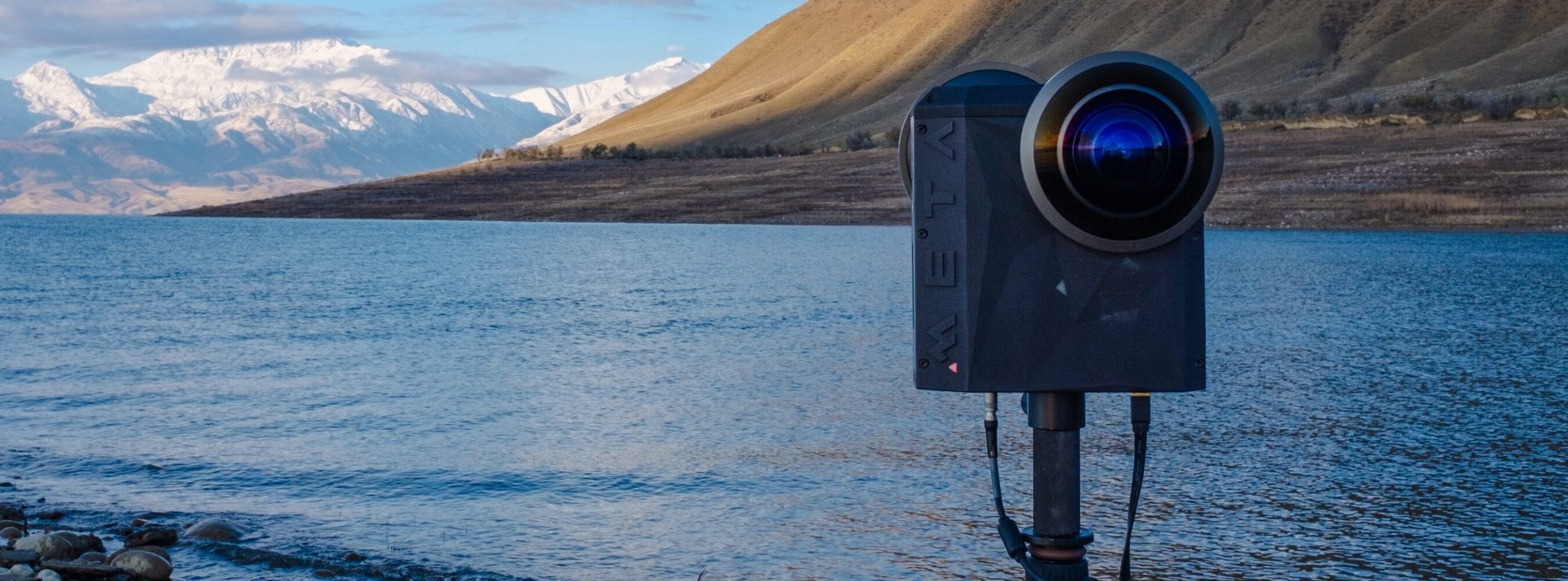
Filming in Kyrgyzstan for the EBRD
360 filming guide · Overview
360 filming / How professional 360 video is made
When we film 360, the whole view is the film, up, down, all around. Someone's going to watch it in a VR headset, stand inside it in an immersive room, or drag it around on YouTube 360. Every direction is in shot, all the time, and the viewer decides where to look. That changes almost everything about how a shoot is planned, lit, directed and finished.
This is how we do it. It's written for people commissioning 360 work, and for crews who've used a consumer camera and want to know what changes when the footage is going in front of an audience.
What changes when the viewer is inside the shot
A consumer 360 camera costs a few hundred pounds now and fits in your pocket. They're very good cameras. But most of them are built for something called overcapture: you film everything around you on a bike, handheld while running or something more extreme like a snowboard, then crop an ordinary flat shot out of it later for social media.
It doesn't much matter how the camera gets thrown about, because nobody ever sees the whole picture. However, when the whole picture is the film, all of that matters.
Comfort comes first
In a headset, the picture moves with your head. If the camera bumps, lurches or speeds up and your body doesn't feel it, your brain notices the mismatch - and that's what makes people feel sick. So when our camera moves, it moves in straight, smooth lines, without hard acceleration or braking. When it's still, it usually sits just below the eye level of the people around it.
They're rules, and once you know them you can break them safely. We do, sometimes. But we know whether a shot will be comfortable before it's ever been near a headset, and that only comes from watching a lot of footage back in a lot of headsets.
Anything that breaks the illusion loses the viewer
What a good 360 film gives you is presence: the feeling that you're actually there, to the point where you forget the room you're standing in. It's fragile. A tripod with wires coming out of it under your feet. A face that warps as someone walks through the join between two lenses. A video that judders because the playback app can't keep up. Any one of them reminds the viewer they're wearing a piece of technology, and you've lost them. Most of what we do on set and in post-production is about protecting that feeling.

Jason Glenister directing for Visualise
You don't have to fill all 360 degrees
In the early days of 360, people felt they had to use every degree of the frame. There'd be something going on in every direction, and viewers didn't know where to look or what the story was. They spent the whole film worried they were missing something.
It works better kept simple. Make it obvious where to look, use movement and sound to turn people's heads, then give them time to look around. That last bit surprises people. Ordinary films cut fast, and in 360 that leaves viewers disorientated and quite frustrated. So the scene has to carry the energy itself, through the action and the performances. We often find it's closer to staging a play than shooting for TV.
People can look you in the eye
One thing 360 does that nothing else quite does: if a presenter delivers their lines straight down the nearest lens, as if it's someone's head, the person in the headset feels they're being spoken to. It's a surprisingly personal feeling, and a good reason to film people closer than you'd expect. Where the film will be shown changes that, though - more on that in Filming 360 for headsets, domes, LED rooms and YouTube.
Why film in 360 at all?
It's a fair question, because 360 usually costs more than an ordinary film. It needs a reason.
The best one is attention. Put a headset on someone at a trade show and the stand, the noise and the person trying to talk to them all disappear. There's no other medium that holds people quite like that. It takes them, as close to literally as we can manage, into your world, whether that's a factory floor, a concert hall or a charity's work in the field.
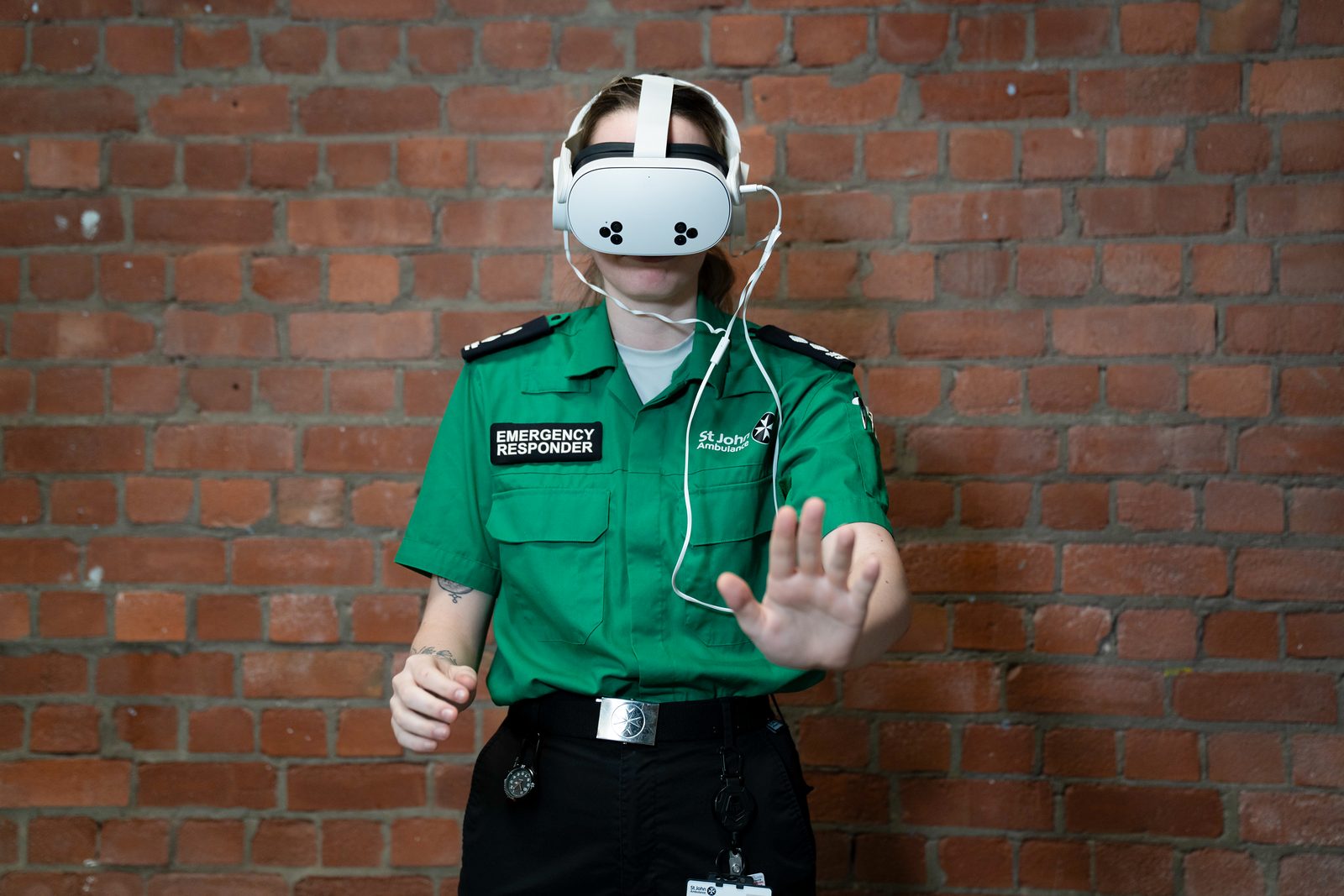
St John Ambulance VR Experience - based on 360 video
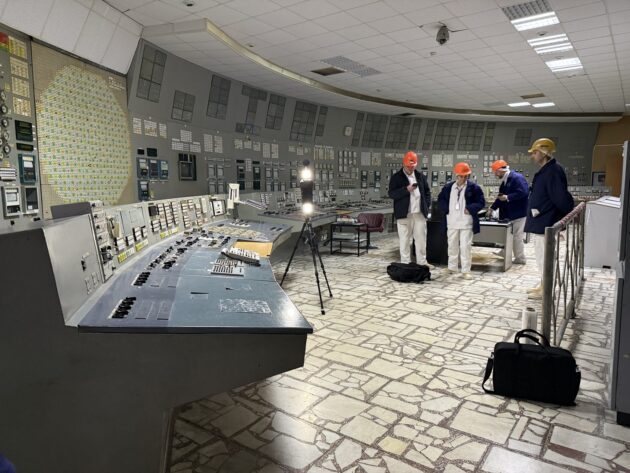
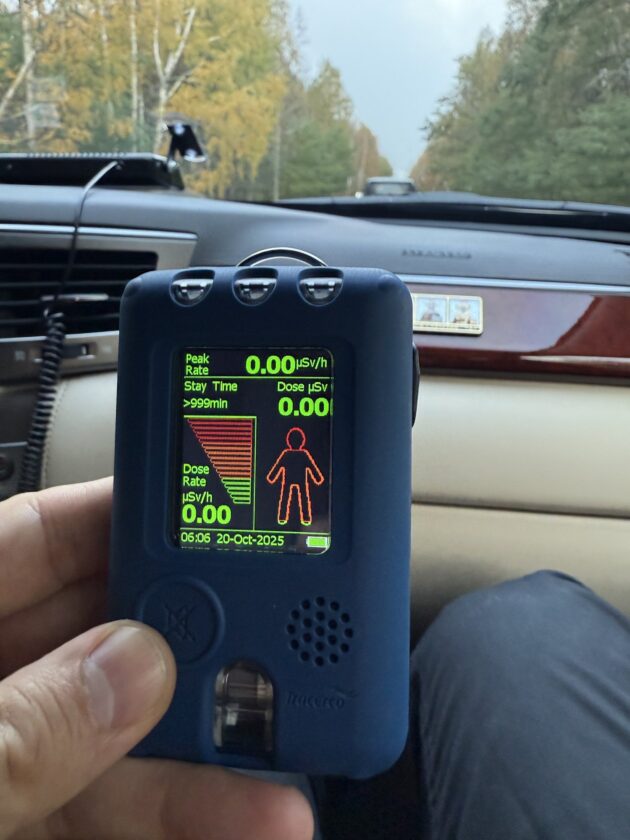
The other is access. You can take one camera somewhere you could never take a hundred people: backstage, a restricted site, somewhere remote or dangerous. For the EBRD we filmed inside the Chornobyl exclusion zone - in the Reactor 3 control room, and up inside the New Safe Confinement after a drone hit it in February 2025. Hardly any of the donors and decision-makers who needed to see it will ever stand there. In a headset, they can. (Chornobyl case study, and Henry's notes from the shoot.)
Travel and culture work the same way. Our Visit Qatar films put visitors at World Travel Market inside walk-in LED rooms, surrounded by Qatar at 12.5K.
To be straight about it, most 360 films are still watched at events, on stands and in private demos, rather than at home. More people own headsets every year, but it isn't a mass audience yet. The bigger change is immersive rooms - Outernet, Lightroom, Frameless, Future Stores - where the public walks into walls, ceilings and sometimes floors of moving picture. They're made for 360 film.
How a 360 shoot runs
Every job's different, but most follow the same shape:
- Pre-production, usually a few weeks. The idea, script, locations and recces, and working out where the film will be shown, because that decides how we shoot it.
- The shoot, usually a day or two. Abroad - the US, Africa, wherever it is - we might be away for a week.
- Post-production, from about three weeks to twelve. Stitching, clean-up, edit, grade and sound.
What moves those numbers is how hard the footage is to finish. A static shot on a tripod in a controlled studio is quick. A walking shot through a busy market, a drone flight or a 3D shoot takes much longer, because every frame needs more stitching and cleaning up. And when a one-day shoot needs turning round fast, we can do that too.
Two ways to work with us
As a technical partner. An agency or production company brings the client, the idea and often its own crew, and we run the 360 side of the shoot and the post-production.
As a creative partner. You bring a problem to solve, a place to show or a story to tell, and we do the rest: script, storyboard, our own directors, casting, rehearsals, locations, art direction, the shoot, the post and, at the end of it all, the headsets on your stand. It can be a very hands-off service. You can come to us at any stage.
One thing worth knowing before the shoot
On an ordinary shoot, the client watches a monitor and sees what they're getting. With 360 it's harder. On some shoots we can run a live preview into a headset, or show the full view on the camera's controller. But with smaller cameras you often can't see it properly until the footage is back, and sometimes not until it's been stitched. On a one-day shoot with no time to review that evening, that means trusting the crew.
We can look at the raw fisheye picture straight off the camera and know how it'll feel in a headset a couple of months later. It's hard to explain how. It comes from shooting a lot of it, and watching a lot of it back.
The guides
- Filming 360 for headsets, domes, LED rooms and YouTube - why the screen decides the shoot: camera height, how close people stand, 3D or flat, 180 or 360.
- 360 cameras and drones - the Meta Three and Meta Four, Blackmagic's 180 camera, heavy-lift drones, the DJI Avata 360 and DJI Osmo, and what we learnt underwater.
- On set: directing, lighting, sound and hiding the crew - the joins between lenses, lighting a room that's all in shot, spatial sound, and some of the odder places we've hidden.
- 360 post-production: stitching, clean-up and delivery - from separate lens files to a finished film that plays smoothly in a headset.
FAQs
How much does professional 360 filming cost?
A documentary-style 360 film starts at around £10,000 plus VAT. A scripted production with cast, locations and VFX can run to £100,000. Most of the difference is shoot days, crew and how much post-production the footage needs.
How long does a 360 film take to make?
Usually a few weeks of planning, a day or two of shooting and three to twelve weeks of post-production. Simple jobs can be much quicker.
Can you work alongside our own crew?
Yes. A lot of our work is as the 360 specialists on an agency's or production company's shoot.
Do you film outside the UK?
Yes - in more than 30 countries so far, from the deserts of Qatar to the Chornobyl exclusion zone.
Should we film in 3D?
Sometimes. It adds depth in a headset but costs more in post-production, and it doesn't help on screens or in rooms. There's more on it in Filming 360 for headsets, domes, LED rooms and YouTube.
Get in touch
Planning a 360 shoot?
Have a look at our 360 video production page, or tell us what you've got in mind.