

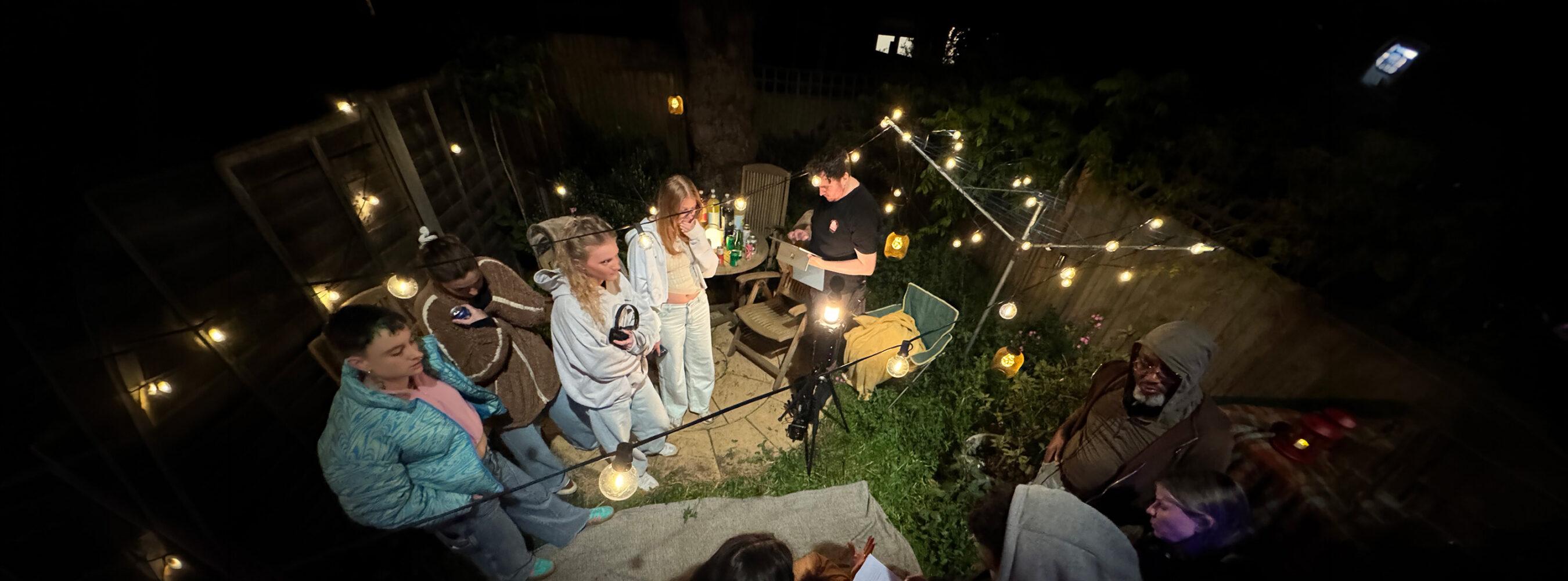
Rehearsing a night scene around the camera
360 filming guide · Part 4 of 5
On set / Directing, lighting, sound and hiding the crew
Most of what makes a 360 film work gets decided on set, and most of it is invisible in the finished film: where the joins between lenses fell, where the lights went, and where the crew was hiding. Some of it sounds simple. It is, once you've done it a few times. But get it wrong and it costs days in post-production, or a shot that can't be saved.
Mind the joins
A 360 camera is several lenses pointing different ways. Where their views meet is the stitch line, the seam where the pictures get joined together. Anything sitting right on it is hard to join cleanly, and anything moving across it is harder still. On a small two-lens camera, if someone's standing side-on to it, where they could see both lenses, they're probably on the seam.
So we place the camera to keep the important action in the middle of a lens. Stitching software has got a lot better at hiding joins, but how the footage was shot still decides how good the join can be. We've been sent footage that was shot without thinking about it, and it never stitched as well as it could have.
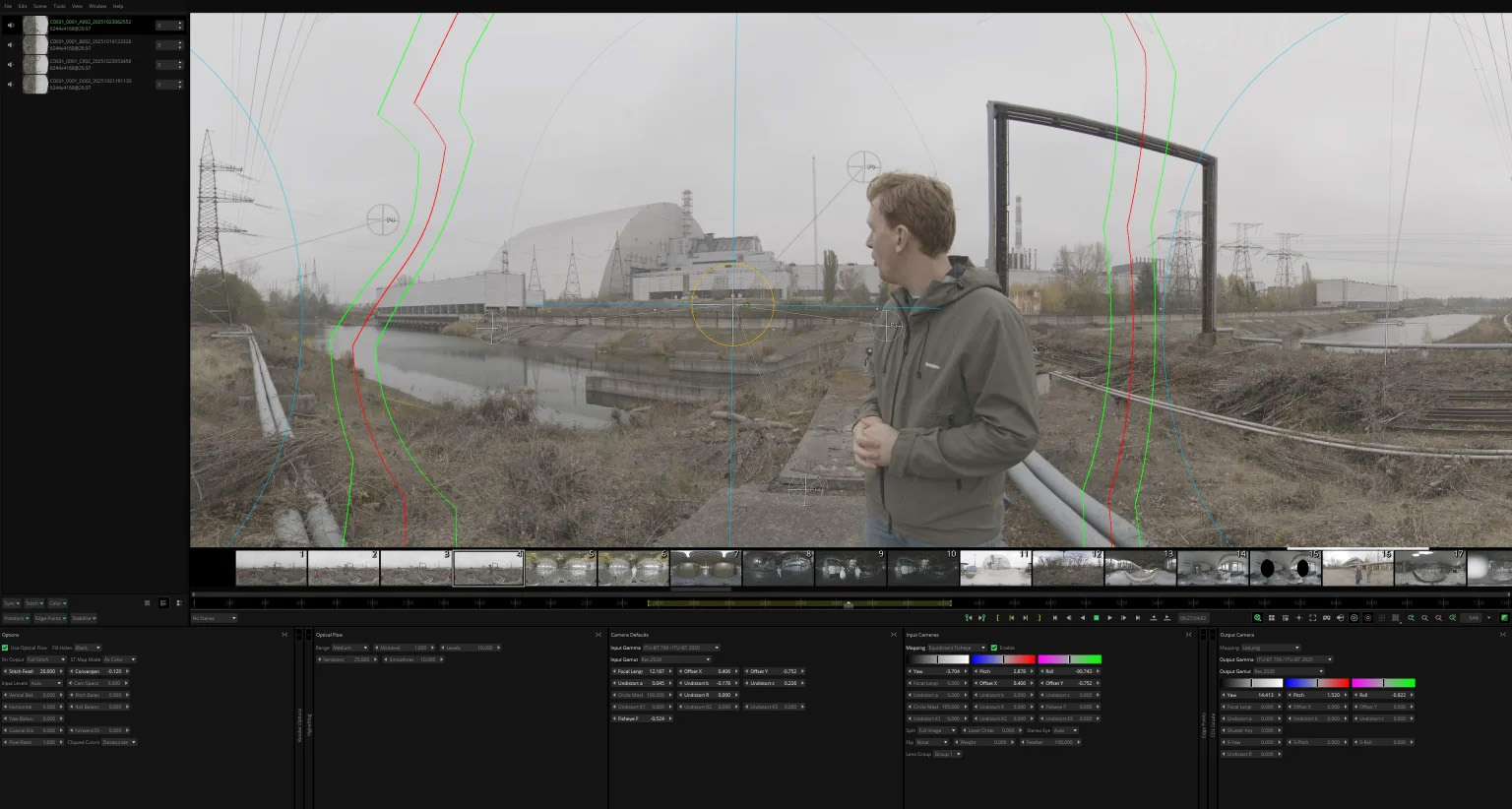
Mistika VR Stitching Chornobyl - EBRD
Moving the camera
If the camera moves, it moves in straight, smooth lines, without hard acceleration or braking, so nobody watching in a headset feels sick. If it's still, it usually sits just below the eye level of the people around it. These are rules you can break once you know them, and we do, carefully. There's more on comfort in How professional 360 video is made.
Guiding the viewer's eye
Nobody's framing the shot for the viewer, so you have to show them where to look. We do it with action, with people and things moving through the frame, and with sound: a door opening, someone walking past, a voice off to one side.
And then we leave them time. 360 needs longer takes and far fewer cuts than an ordinary film, so people can settle in and look around before the next thing happens. We often find directing it is closer to staging a play than shooting for TV. (We wrote about the films doing this best in The best immersive films this month barely cut the camera.)
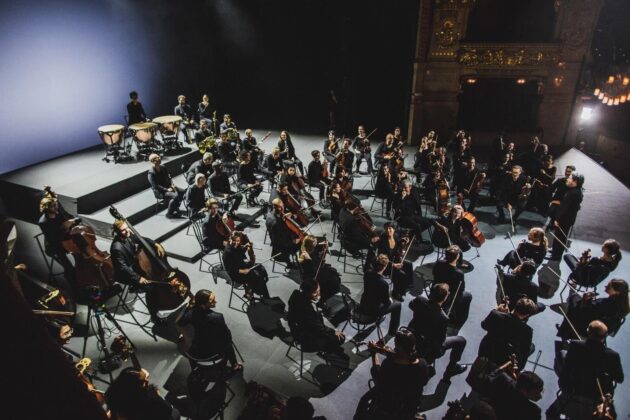
For people talking to camera, and why it's worth getting them to look down the lens, see 360 for headsets, domes and LED rooms.
Lighting a room that's all in shot
The camera sees everything, so any light you add is in the shot. That rules out most of what a lighting team would normally do.
We often fix small lights to the camera itself, but they're for fill, lifting the shadows a bit, and won't light anyone properly. The best light for 360 is natural or hidden. That means practicals, which are just the lamps and lights that belong in the scene anyway, plus lights tucked behind furniture and round corners.
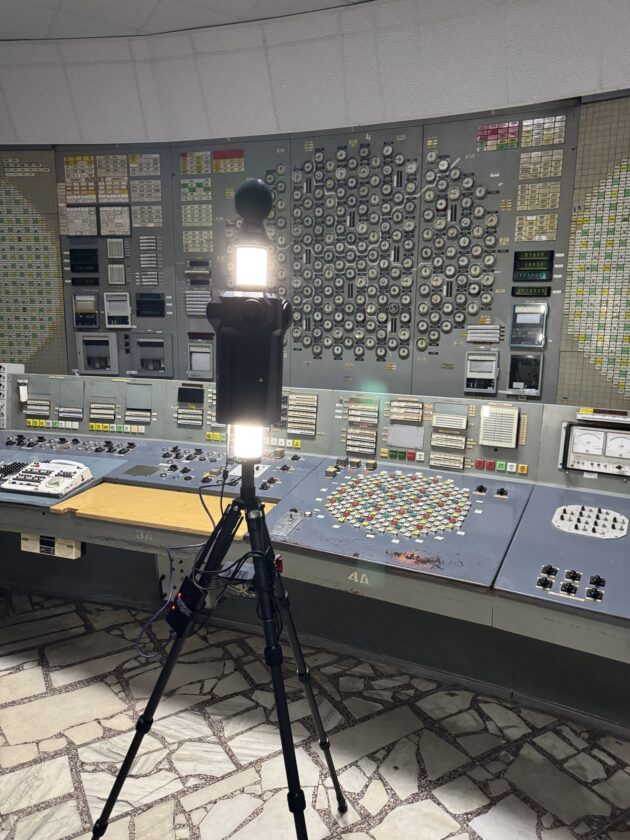
When that won't do the job, we put lights where we need them and paint them out afterwards. For that we shoot a clean plate: the same view with the lights, stands and kit taken away, so the empty background can be pasted back over them in post. It needs planning, though. A light in the wrong place can be a much bigger job to remove than it looks on the day.
Hiding the crew
There's no behind the camera in 360, so for every take everyone has to go somewhere. We've hidden behind walls and round the edges of doors, queued up behind a lamppost, and lain flat behind a tiny wall and in the snow. When there's nowhere to hide at all, we stack everyone in one spot that we know we can clean out afterwards with a clean plate.
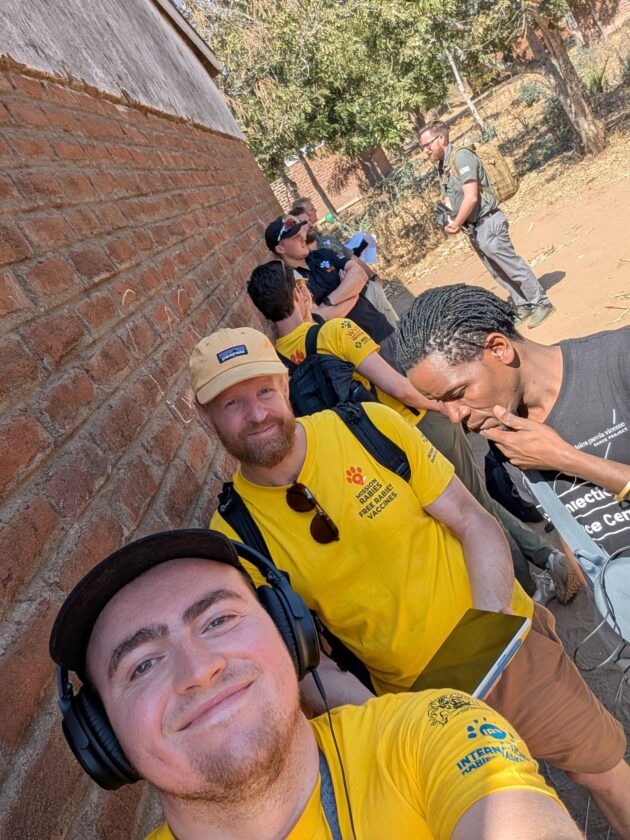
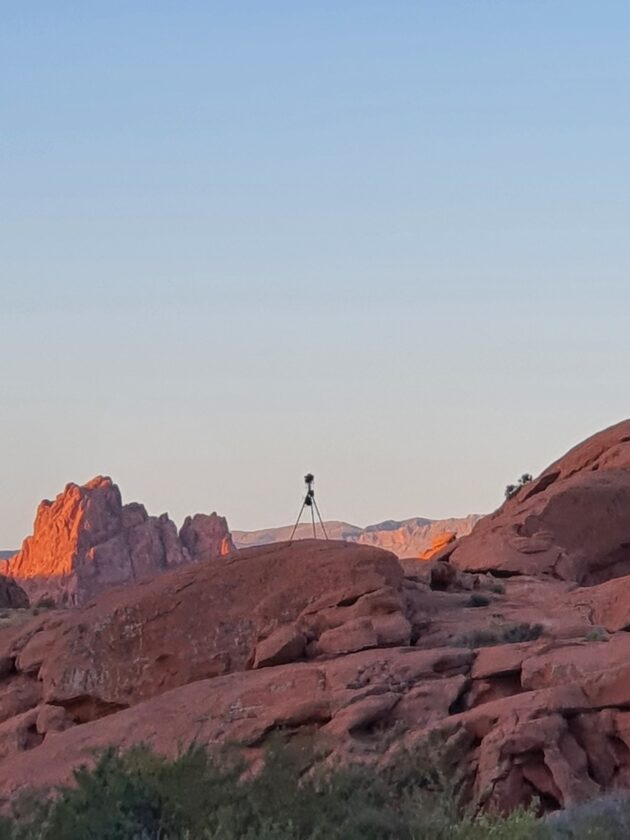
It's quite funny, and we've got the photos to prove it. But it needs thinking through. If the whole crew ends up in the back of the shot with no plan for removing them, that's a real headache in post. And if there's nowhere for anyone to go, the shoot slows right down.
Sound that moves with your head
In a headset, the picture moves when you turn your head, and the sound should too. If someone speaks on your left and you turn to face them, their voice should now come from in front of you. That's spatial sound, and it's a big part of why a good 360 film feels like being somewhere.
Your brain works out where a sound is coming from partly by how much louder it is in one ear, and partly by the tiny delay between it reaching one ear and then the other. Spatial sound keeps both right as you move. It's also one of our best tools for steering attention, because a sound behind you is the quickest way to make someone turn round.
On set we usually pair an ambisonic microphone, which records sound from every direction at once, with small clip-on mics on anyone speaking. Then our Head of Sound, Henrik Oppermann, places everything in the scene in post-production. He's recorded everything from orchestras to forests this way.
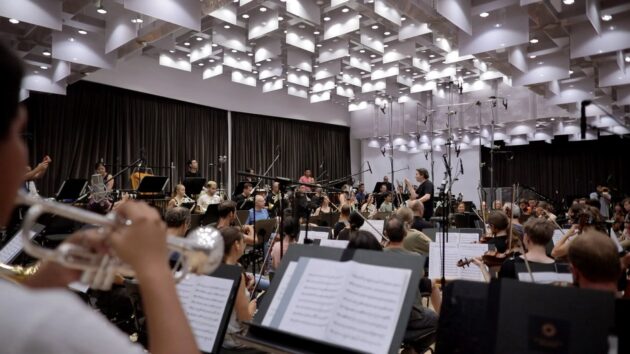
A 360 film can go out with ordinary stereo sound, and sometimes that's enough. In a headset, though, spatial sound makes a big difference. And the kit keeps improving. Most portable ambisonic microphones record what's called first or second order. In November 2026 Blackmagic announced a seventh-order one with 108 tiny microphones, which can place sounds far more precisely.
FAQs
How do you hide the crew in a 360 shot?
Behind walls, doors, lampposts and anything else that's handy. When there's nowhere to go, we put everyone in one place and remove them in post using a clean plate.
Can you light a 360 shoot?
Yes. Mostly with natural and hidden light, small lights on the camera for fill, and lights we paint out in post when a scene needs more.
Why do 360 films use so few cuts?
People need time to look around. Fast cutting in 360 leaves viewers disorientated and quite frustrated, so the scene has to carry the energy itself.
Do we need spatial sound?
For headsets, we'd always recommend it. For screens, rooms and YouTube, it depends how the film will be played.
Can the client watch the shoot live?
Sometimes. On some shoots we can run a live preview into a headset or show the full view on the camera's controller. With smaller cameras, you often can't see it properly until it's stitched.
Get in touch
Planning a 360 shoot?
Have a look at our 360 video production page, or tell us what you've got in mind.